The Gigawatt Buildout
· edited · Jai An
The AI labs have committed to a datacenter buildout that, on the high-end arithmetic, costs a single-digit percentage of US GDP — every year, for years. This essay works that claim from the biggest possible frame down through the unit economics of a single gigawatt to the one piece of electrical equipment currently gating the whole thing. Every number is sourced; the full source notes live in the appendix.
If you only remember five numbers
- $3–7.5T gets spent on AI datacenters in the next five years — up to ~5% of US GDP, every year. Railroad-buildout territory.
- The world has ~25 GW of AI compute today; the realistic path lands at ~220–300 GW by 2030. Gigawatts double every ~18 months — it's compute that triples.
- One gigawatt costs ~$40–60B all-in to build. Rental still ~$10B/yr; a frontier lab now earns as much as ~$50B/yr from the same watt.
- High-voltage transformer lead times went from 24–30 months to ~5 years — and ~11 of the 12 GW announced for 2026 is stalled. The transformer queue, not chips or capital, is the clock.
- The Mag 5 now spend ~66% of operating cash flow on capex, heading for ~75% by 2030. In 2015 it was 27%.
Published 2026-06-12 · Last edited 2026-09-01. Edits: 2026-06-22 regulation + RSI wildcards; 2026-07-13 Meta Louisiana $250B/5 GW; 2026-07-14 BofA FCF-transfer chart; 2026-09-01 Dwarkesh × Dylan Patel, Aug 25 fact-check.
The biggest frame first
Somewhere between $3 trillion and $7.5 trillion is going to be spent building AI datacenters over the next five years, depending on whose scope you take. The low end is the BG2 headline — ~$3T of total AI capex the industry is trying to absorb this cycle. The high end is Jamin Ball's arithmetic in The Neocloud Boom: ~$50B to build a gigawatt, times ~150 GW of new capacity by 2030, equals $7.5T. David Cahn at Sequoia splits the difference by reframing the question: 100 GW is AI's "$8 trillion question," 250 GW is the "$20 trillion question."
Numbers that size stop being a tech-sector story. Spread over four and a half years, the high-end path is ~$1.7T per year against a ~$32T US economy — about 5% of GDP, every year. For calibration (Ball's comparison set): the railroad buildout of the 1880s peaked around 6% of GDP, telecom in the early 2000s was ~1.2%, and the Manhattan Project was ~0.4%. We are watching something between telecom and the railroads, and it is being financed mostly by five companies' operating cash flow.
This post walks that claim from the top down: how much compute exists today and how fast it's growing, what one gigawatt actually costs (and why published numbers disagree by 4–5×), who's paying the bill and with what instruments, what a deployed gigawatt is worth once it's live, what physically gates the build, and what breaks if the curve stops paying.
Where the world is in 2025
Roughly 20–25 GW of AI compute exists globally — that's Elon's framing on Cheeky Pint ("the world has maybe 20, 25 gigawatts of compute"), and it's consistent with Dylan Patel's numbers. About 10–15 GW of that was built in 2025 alone (Dario, on Dwarkesh), with ~20 GW of incremental US capacity added in 2025 (Dylan). The US has ~5,400 datacenters — more than every other major country combined, roughly 10× Germany at #2 (Cloudscene / Kobeissi). Hyperscalers are already the largest growth vector, but the clean current-capacity number is ~44–48% of global datacenter capacity in 2025, with ~60% projected around 2030.
In other words: the installed base is small relative to the ambition, and the growth rate is the entire story. A fifth to half of everything that exists was built in 2025 alone.
The trajectory to 2030
The most-cited path is Dario's curve — industry build roughly tripling every year:
| Year | Industry GW (built that year) | Silicon-only @ $10–15B/GW (Dario) | Full system @ $40–60B/GW (Cahn/Jensen) |
|---|---|---|---|
| 2025 | 10–15 GW | $100–225B | $400–900B |
| 2026 | 30–40 GW | $300–600B | $1.2–2.4T |
| 2027 | ~60 GW (BG2 normalization) | $600–900B | $2.4–3.6T |
| 2028 | ~100 GW | $1.0–1.5T | $4.0–6.0T |
| 2029 | ~300 GW | $3.0–4.5T | $12–18T |
| 2030 | up to ~200 GW (ASML hard ceiling, Dylan) | $2.0–3.0T | $8–12T |
Two dollar columns because the per-GW figure depends on what you count (next section). Dario's $10–15B is silicon only; Cahn/Jensen's $40–60B is the full powered shell + system. The full-system column blows past most published forecasts after 2028 — which is why the 2029–30 GW path is the load-bearing assumption to stress-test, not the dollar figure.
The ~200 GW number is a hard physical ceiling Dylan derives from EUV-tool throughput: ~3.5 EUV tools per GW of AI silicon, against ~700 EUV tools in the world by 2030 (ASML constraint). Sam Altman's stated target of ~52 GW/yr would consume a quarter of global lithography capacity for one lab. And note the contradiction hiding in the table: Dario's ~300 GW in 2029 is above Dylan's 200 GW ceiling for 2030. Either Dario is rounding the curve up, Dylan's EUV math is conservative, or the path bends before 2029. They can't all be right.
Per lab, the best estimates ("—" = not publicly disclosed):
| Lab | End 2025 | End 2026 | End 2027 | Stated 2028–2030 ambition | Share of 2025 industry |
|---|---|---|---|---|---|
| OpenAI / Stargate | ~2 GW | ~6 GW | ~12 GW | 50 GW (Sam target); $150B capex 2030 | ~8–10% |
| Anthropic (rented, AWS+Google) | ~1.5 GW | ~4.5 GW | ~8 GW (3.5 GW Google TPU online) | 10+ GW | ~6–8% |
| xAI / Colossus | ~0.5–1 GW (Memphis) | ~2 GW (Memphis target) | 3+ GW (Colossus 2, 1M+ GPUs) | — | ~3–5% |
| Meta (Hyperion + Prometheus) | ~2 GW | 3+ GW | 5+ GW | multi-GW commitments | ~8–10% |
| Microsoft | ~4–5 GW (incl. OpenAI co-located legacy) | 6+ GW | 8+ GW | — | ~20% |
| ~5+ GW (largest aggregate, undisclosed) | 7+ GW | 10+ GW | — (signed 1 GW just for demand response in early 2026) | ~25%+ | |
| Industry (sum) | ~20–25 GW | 30–40 GW | ~60 GW | 100–300 GW/yr | 100% |
Caveats: Anthropic and OpenAI numbers are consumed compute (rented). Google and Microsoft mix AI + cloud and don't publicly separate. Percentage shares are illustrative — they wouldn't sum to 100% if you double-count the OpenAI/Microsoft and Anthropic/Google cloud relationships.
This is also where Ball's 150 GW comes from, by a different route: OpenAI has talked publicly about 30 GW by 2030; assume Anthropic has similar plans and the two labs alone bring ~55 GW; if they're 30–40% of new builds, the industry adds >150 GW in 4.5 years. That lands comfortably inside Dario's path and well above the realistic construction floor (see the transformer section below) — a useful midpoint between the optimists and the pipeline data.
August 2026 update — two labs, most of the FLOPs
The tables above were locked against Dylan's earlier Dwarkesh episode. He came back on August 25 with a follow-up — same lenses, several load-bearing figures moved. I checked this post against the transcript.
What held. OpenAI started 2026 at ~2 GW; Anthropic below 2 GW. Compute still costs ~$10–15 million per megawatt to rent. The Vera Rubin wafer recipe is unchanged (55k N3 / 6k N5 / 170k DRAM per GW). Full-system build cost is still in the $40–50B/GW band — SpaceX is leasing at ~$40B/GW to Google and ~$50B/GW to Anthropic. Transformers and EUV mirrors remain the clocks. 100 ASML tools a year is still his 2030 number.
What moved.
1. Both labs end 2026 above 5 GW. The per-lab table had Anthropic at ~4.5 GW; Dylan now has both OpenAI and Anthropic above 5 GW by year-end — a 3–4× year. The 3× path he is willing to run is 2 → ~6 (end 2026) → 18 (end 2027) → 54 (end 2028) per lab, ~100 GW combined by end 2028, which would be 70–80% of incremental world compute. Half of incremental new compute is already going to the two labs by end of 2027 (signed deals: 40–50% next year; ~30% of 2026 additions). SpaceX is the new lessor; OpenAI is standing up its own chips; Anthropic is buying TPUs from Google and deploying them with Fluidstack.
2. World additions are faster than the realistic ladder below. His current incremental path: +30 GW in 2026, +50 in 2027, ~+70 in 2028, +90–100 in 2029. That lands ~200 GW of global AI compute by end 2028 — above this post's realistic 90–120 GW installed that year — and he calls ~80 GW of 2028 additions the bullish upper bound. World gigawatts, in this telling, double every year, not every 18 months. The efficiency wedge still does the rest: GB300 / TPU v7 / Trainium 3 are 3–5× the prior generation's performance per watt, so two labs taking ~45% of new watts in 2027 can still control most usable FLOPs by end 2028 even if they don't own most of the watts.
3. A live gigawatt earns more than the rental comps. The ~$10B/yr rental yardstick still describes what CoreWeave-class capacity transacts at (most compute still "sub-$20B a gigawatt"). It no longer describes what a frontier lab earns from a gigawatt. GPT-4 on Hopper was negative gross margin; GPT-5.6 / Opus 5 / Fable 5 clear well past the $10–15M/MW cost. Anthropic has printed as high as $50 million per megawatt (~$50B/GW/year). His "right now" end-revenue figure is $100B per gigawatt of chips; he doesn't see why lab revenue wouldn't be $50M+/MW by end 2027, with $70–80M/MW blended on the table. That is a 5–10× gap versus the rental number this post used to underwrite the build. Anthropic turned a profit in Q2 2026; OpenAI is believed capable of it in Q3 on Codex and 5.6.
4. Capex this year is already the trillion. "A little over a trillion dollars of CapEx this year," more than $2 trillion in 2028. Labs go from tens of billions of annual spend to hundreds of billions, with contracts already pointing at trillions toward the end of the decade. $6B of fab capex produces a gigawatt of chips every year against $100B of end revenue — a ~100× discrepancy even after haircutting middlemen in half — which is why the ASML-mirror bottleneck is now an emergency rather than a 2030 problem. If the 100 GW/year run-rate ever lands, he puts all-in capex (IT + shells + power plants bought years ahead) at $7–10T/year, approaching a quarter of the US economy. That's the 5%-of-GDP frame in this post, taken to its limit.
5. China is further behind than the power-growth gap implied. Sub-10% of incremental AI watts are being deployed in China; ≤30 GW by 2028, with a "completely reasonable" 50 GW of (worse) domestic chips in 2029. Leading Chinese labs have 100–200 MW (ByteDance Seed the outlier) against Anthropic's >5 GW by year-end. Export controls plus American willingness to YOLO into startups is, in his telling, actually working — for now.
The regulation wildcard later in this post now has a Dylan-side confirmation: the best model in the world was trained in February, Mythos isn't out, OpenAI paused training for two weeks, and if labs can't ship their best models, revenue-per-megawatt stalls and they can't outbid the world for 100 GW. Same channel as the Fable/Mythos kill-switch — now showing up in the unit economics, not just the demand curve.
The realistic ladder, year by year
"3× per year" invites a tempting misreading: the installed base tripling — ~25 GW today, 75 GW in 2026, 225 GW in 2027. Nobody is claiming that. Dario's 3× is the build rate (GW constructed per year), and even that is the aspiration curve. What the grid physically delivers grows slower than both. Since the three ladders differ by hundreds of gigawatts within three years, they're worth laying side by side:
| Year | "Stock ×3" misread (GW installed) | Dario's build curve, summed (GW installed) | Realistic power ladder (GW installed) |
|---|---|---|---|
| 2025 | 25 | ~22 | 20–25 |
| 2026 | 75 | ~60 | ~35–45 |
| 2027 | 225 | ~120 | ~55–75 |
| 2028 | 675 | ~220 | ~90–120 |
| 2029 | ~2,000 | ~520 | ~140–190 |
| 2030 | — | ~720 | ~220–300 |
The realistic column grows ~1.6–1.8×/yr — doubling roughly every 18 months, a power-sector Moore's law. Three reasons it sits below the other two:
1. Compute grows faster than power by construction. Each chip generation does more compute per watt — Epoch AI measures ML-GPU energy efficiency doubling every ~3 years at FP32 (~1.26×/yr), with bigger step-changes from tensor cores and lower-precision formats (tensor-FP16 alone is ~10× FP32 throughput). SemiAnalysis measured total AI compute capacity growing 50–60% per quarter through 2023–24 while power grew far slower. So a 3×/yr compute story never required 3×/yr gigawatts; roughly 2×/yr of power carries it.
2. The grid delivers about half of what's scheduled. Goldman Sachs Research (on Aterio's facility-level tracker): US datacenter additions actually realized were 6.4 GW in 2024 and 8.5 GW in 2025; the construction schedule says 13.6 GW (2026) and 36.3 GW (2027), but historically only ~72% of capacity scheduled within four quarters goes live on time, and Goldman risk-adjusts to ~60% materializing on a one-year view, ~50% on two — supply chains, labor, and the 18–24-month build cycle eat the rest. That's the same gap Sightline's 11-of-12-GW-stalled number measures from the transformer side.
3. The model-based forecasts agree. SemiAnalysis's energy-dilemma model had AI datacenter critical IT power crossing 10 GW in early 2025 and reaching ~40 GW by 2026 (within global all-datacenter demand going 49 GW in 2023 → 96 GW in 2026) — steep doubling off a small base, decaying as the base grows. Goldman's headline is US datacenter power doubling 2025→2027, not tripling.
The dollars confirm the middle can't hold a 3× stock curve: the misread's 2027 step (+150 GW in one year) at $40–60B/GW all-in is $6–9T of capex in a single year — ~10× actual Big-4 spend (~$600B/yr). The realistic ladder's 2027 step (~+20 GW) is ~$0.8–1.2T/yr — right on Dylan's ~$1T full-ecosystem run-rate. And the 2030 landing zone (~220–300 GW installed) is exactly the range the money people are already debating — above Ball's ~150 GW of new capacity, spanning Cahn's "100 GW = $8T question, 250 GW = $20T question," and safely under Dylan's 200 GW/yr ASML ceiling on annual chip output.
So when someone says "AI compute triples every year," the year-by-year translation for the power ladder is: ~25 GW now → ~40 in 2026 → ~65 in 2027 → ~100 in 2028 — not 75 and 225. Compute can triple; gigawatts double at best, every 18 months, transformer queue permitting. Dylan's August 2026 path (+30 / +50 / +70) is the bullish bound sitting above this column — see the update section.
What one gigawatt costs
Published cost-per-GW figures range $10–60B, and the spread is mostly about what's included in the lens, not real disagreement:
| Lens | What's counted | Number |
|---|---|---|
| Silicon / chips per delivered GW | GPUs + HBM only (not the building, not the power) | Dario: $10–15B/GW |
| Powered shell + facility per GW | Land, permits, building, transformers, switchgear, cooling, on-site power, networking — but not the compute itself | Chamath's project escalation traces this lens: $4–5B → $50B |
| Full AI system capex per delivered GW | Silicon + powered shell + networking + service margin + memory; the headline build cost | Cahn: ~$40B/GW · Jensen: $50–60B/GW with Vera Rubin |
These stack rather than conflict: ~$10–15B of silicon riding on ~$25–45B of powered shell and infrastructure equals ~$40–60B all-in per delivered GW.
A live confirmation of the top of that stack landed in July 2026: Meta disclosed that its Richland Parish, Louisiana campus — Hyperion, its largest — is scaling to at least 5 GW at an expansion cost of ~$50B, with total site investment now past $250B (an additional $40B committed on top of prior spend) (Bloomberg, Jul 2026). That's ~$50B per delivered gigawatt all-in — landing squarely on Jensen's full-system number, and this time from a single operator's own capex disclosure rather than an analyst's model. (For scale: the site has already awarded >$1.6B in contracts to Louisiana businesses since breaking ground in December 2024, for ~1,000 permanent jobs once live — the buildout's labor footprint is thin relative to the capital.)
Ball's decomposition of the ~$50B adds line-item granularity for a Blackwell-era build: ~70% chips/compute (50% GPUs, 10% networking, 5% CPUs, 3% storage, 2% assembly), ~20% datacenter shell + power infrastructure (substations, transformers, switchgear, backup generation, HV interconnect), ~5% cooling, and ~5% land, permitting, and other.
One genuine disagreement worth flagging: Ball puts ~70% of the $50B on chips/compute — roughly $35B/GW — where Dario's silicon-only lens says $10–15B/GW. That's not a rounding difference; it inverts which slice is "big." The likely reconciliation is that Ball's 70% counts full GPU systems at market price — servers, networking, NVIDIA's margin baked in — while Dario is counting something closer to bare silicon cost. But it's the one place in this post where two careful sources are actively measuring the same lens and getting different answers, so it's flagged in the divergence table at the bottom.
The total bill, and who pays it
Multiple capex lenses converge on the same shape — steep through 2026, flattening after 2028:
| Year | Mag 5 capex (BG2) | Big-4 hyperscaler (Dylan) | Total ecosystem (Dylan, incl. supply chain) |
|---|---|---|---|
| 2023 | $156B | — | — |
| 2024 | $241B | — | — |
| 2025 | (jump) | ~$600B | ~$1.0T |
| 2026 | $379–450B | rising | rising |
| 2028 | $535B | — | — |
| 2030 | $568B | — | — |
The scopes nest — BG2's Mag 5 ⊂ Dylan's Big 4 + supply chain ⊂ Dario's whole industry — so the 1.5–2× gaps between them are definitional, not contradictions. Cumulative 2025–2030, the industry is trying to absorb ~$3T of AI capex on the narrow scope and $7.5T+ on the full-system × 150 GW scope. NVIDIA alone: ~$160B/yr of revenue today, consensus ~$350–400B/yr in five years.
An independent cross-check from the profitability-tracker side: Is AI Profitable Yet? tracks cumulative AI spend vs. AI revenue per company (May 2026 snapshot). Its Big-4 annual burn — Google $155B, Amazon $174B, Microsoft $153B, Meta $142B — sums to ~$620B/yr, right on Dylan's ~$600B Big-4 capex figure, and its ~$1.1T of cumulative Big-4 AI spend since 2022 is consistent with the BG2 capex curve. Same shape, measured from the spend ledger instead of the buildout.
The chart that first stopped me, from the BG2 "$3 Trillion CapEx" segment — Mag 5 capex as a share of operating cash flow, 2015 → 2030E:
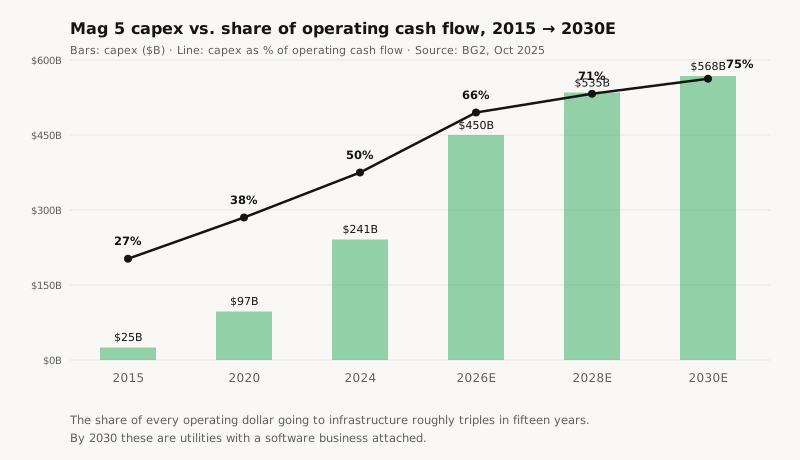
The share roughly triples in fifteen years. The Mag 5 now spend the majority of every operating dollar on infrastructure, most of it AI. Whether that's the new normal or peak overshoot is the trillion-dollar question — but either way it's a different valuation regime from "asset-light platform business." These are utilities with a software business attached.
That regime change shows up as a generational transfer of free cash flow — which is exactly how BofA's Research Investment Committee labels it. For most of the last fifteen years the hyperscalers were the cash machines and the chipmakers were cyclical also-rans; the buildout inverts the two:
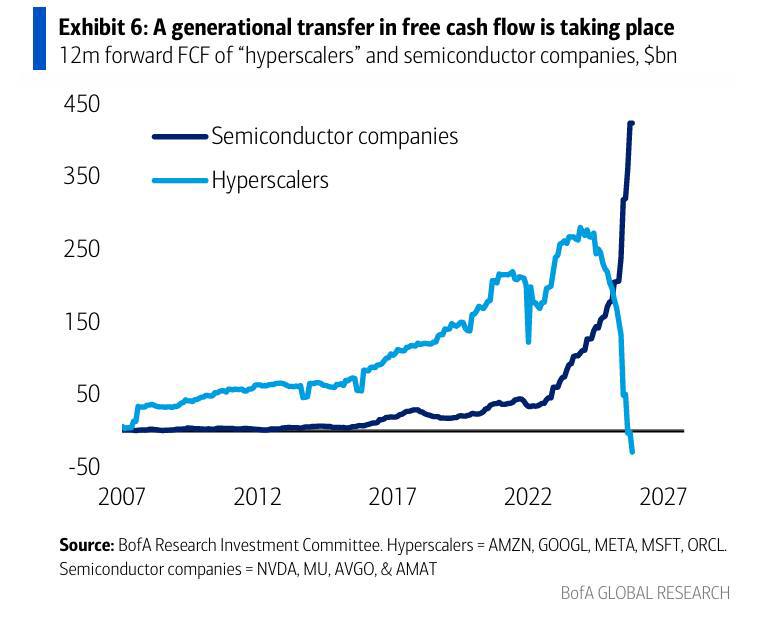
Hyperscaler 12-month-forward FCF (AMZN, GOOGL, META, MSFT, ORCL) climbed past ~$280B by 2024 and is now projected to cross into negative territory as capex outruns operating cash — while the semiconductor names capturing that spend (NVDA, MU, AVGO, AMAT) see forward FCF rocket from near-zero toward ~$420B. It's the "who pays" question rendered as a single crossing: the money isn't disappearing, it's relocating one layer down the stack. That's the ~70%-chips-of-$50B lens from the cost section showing up in the cash flows — most of every capex dollar the hyperscalers spend lands on NVIDIA and its supply chain, so one set of forward-FCF lines goes negative at exactly the moment the other goes vertical.
How the bill actually gets financed is at least as interesting as its size, because the instruments are getting exotic:
- The largest balance sheets in the world are explicitly in. Hyperscaler opex allocation plus sovereign wealth funds — hundreds of billions of committed dollars. Capital formation, the supply-side question, looks answered.
- But a meaningful share of "investment" is barter. NVIDIA and hyperscaler "investments" into the labs flow substantially as hardware and cloud services exchanged for equity, not cash. Chips and compute capacity get marked up into equity stakes — capital-efficient for the suppliers, but it means headline dollar amounts overstate the cash actually changing hands.
- Warrants and rights-to-purchase are becoming the medium of exchange. Equity-linked options now show up on both sides of the compute trade. Supplier takes upside in the customer: NVIDIA's $2.1B partnership with IREN (May 2026) includes a five-year right to purchase up to 30M IREN shares at $70, alongside IREN's 2 GW Sweetwater campus. Supplier hands upside to the customer for the privilege of being chosen: AMD's deal with OpenAI (Oct 2025) included warrants for up to ~160M AMD shares — roughly 10% of the company — tied to a 6 GW chip commitment. In both directions, cash flows are getting overlaid with equity claims so deal economics scale with the buildout itself, not the headline dollar amount.
- And the loop may be too big to fail. NVIDIA recycling profits into lab equity to the tune of tens of billions, which ideally converts into revenue at a ~30× ARR markup that feeds public-market buyers — NVIDIA seems unlikely to let OpenAI or another big lab fail. We may have entered too-big-to-fail territory for private companies.
Five percent of GDP
Take the full-system arithmetic seriously for a moment: $50B per gigawatt × 150 GW = $7.5T over ~4.5 years ≈ $1.7T per year ≈ 5% of US GDP (~$32T/yr). Ball ran exactly this calculation and pulled the historical precedents that make it legible:
| Buildout | Peak share of US GDP |
|---|---|
| Railroads, 1880s | ~6% |
| AI datacenters, 2026–2030 (projected) | ~5% |
| Telecom, early 2000s | ~1.2% |
| Manhattan Project | ~0.4% |
So: bigger than telecom by ~4×, bigger than the Manhattan Project by an order of magnitude, just shy of the railroads. High, but with precedent — and the precedent cuts both ways. The railroads built infrastructure that compounded for a century and wiped out a generation of investors on the way; telecom's dark fiber eventually carried the internet, after the equity went to zero. A buildout at this share of GDP changes interest-rate sensitivity, energy markets, and industrial labor allocation simultaneously — it's already a macroeconomic event regardless of how the AI bet itself resolves. ($3T over five years is also ~4–5× the entire global VC market in its 2021 peak year of roughly $640B, for a sense of how far outside venture-scale this is.)
Dario's macro view bookends it from the demand side: he expects 10–20% real GDP growth per year post-AGI — against compute itself growing ~300%/yr. Even on the optimistic case, compute outruns the economy that's supposed to absorb it.
What a live gigawatt is worth
Capex is only half the ledger. The other half — and the reason the spend might be rational — is what a gigawatt is worth once it's energized and rented.
Ball's yardstick from the public neoclouds: CoreWeave and IREN both trade at roughly $90B of enterprise value per live gigawatt (Nebius meaningfully higher). He's upfront that this is "fun math" on a made-up multiple — but as a unit of account it does real work. If $90B of EV per deployed GW held across 150 GW of new capacity, that's $13.5T of implied enterprise-value creation in 4.5 years. Even discounting hard — much of the build is hyperscaler-internal and never sellable, so say neoclouds capture only ~20% — that's still $2.5T+ of equity value for the sector serving the buildout.
The revenue side roughly cross-checks the multiple. Dylan's earlier rental math puts a GW at ~$10B/yr of compute revenue (Anthropic's incremental $40B of compute spend ≈ 4 GW of inference), Sarah Frier's earlier rule of thumb was "every gigawatt is about $10B in revenue," and CoreWeave's own guidance (~$18.5B annualized run-rate against ~1.7 GW by end of 2026) lands at ~$11M/MW — call it $10–11B of revenue per live GW per year. $90B of EV per GW is then ~8–9× revenue, which is rich but not insane for infrastructure with locked five-year contracts; H100 economics ($2.40/hr signed vs. ~$1.40/hr build cost) show 35%+ gross margins for whoever locked in early.
That rental number is still what most compute transacts at. It is no longer what a frontier lab earns. In the August 2026 follow-up, Dylan has Anthropic printing as high as $50M/MW (~$50B/GW/year) on Opus 5 / Fable 5, with $100B/GW as the current end-revenue figure for a gigawatt of chips and $70–80M/MW blended on the table by end 2027. SpaceX selling B300s to Google at $40B/GW and to Anthropic at $50B/GW is the same spread from the other side of the trade: the lab can pay 3–5× rental because the tokens clear 5–10× cost.
Numbers this large can't be served by a few players — which is Ball's actual thesis: expect a neocloud boom, a handful of very large players plus a long tail of independents (down to single-site operators), the way the independent power producer market evolved. Expect private equity to play a big role. And the SpaceX/xAI datapoint suggests the revenue ceiling per MW may be higher than the comps: per the SpaceX S-1, Anthropic is paying ~$15B/yr for roughly 500 MW of Colossus capacity — ~$30M/MW, ~3× the neocloud norm — which reads as a compute-constrained buyer stretching on a cancellable contract, and as a measure of how much desperation pricing exists in the current market.
What actually gates the build
None of the trajectory math survives contact with the supply chain unless the physical bottlenecks clear. Ranked by how binding they look right now:
1. High-voltage transformers — the active constraint. Sightline Climate's 140-project tracker (via Aakash Gupta) shows the announced-vs-built gap on 2026 US capacity is brutal: 12 GW announced, ~11 GW of it stalled at the announcement stage with no physical progress, and only ~5 GW separately under construction. A quarter of announced projects haven't disclosed a power strategy at all — vapor capex with a press release attached.
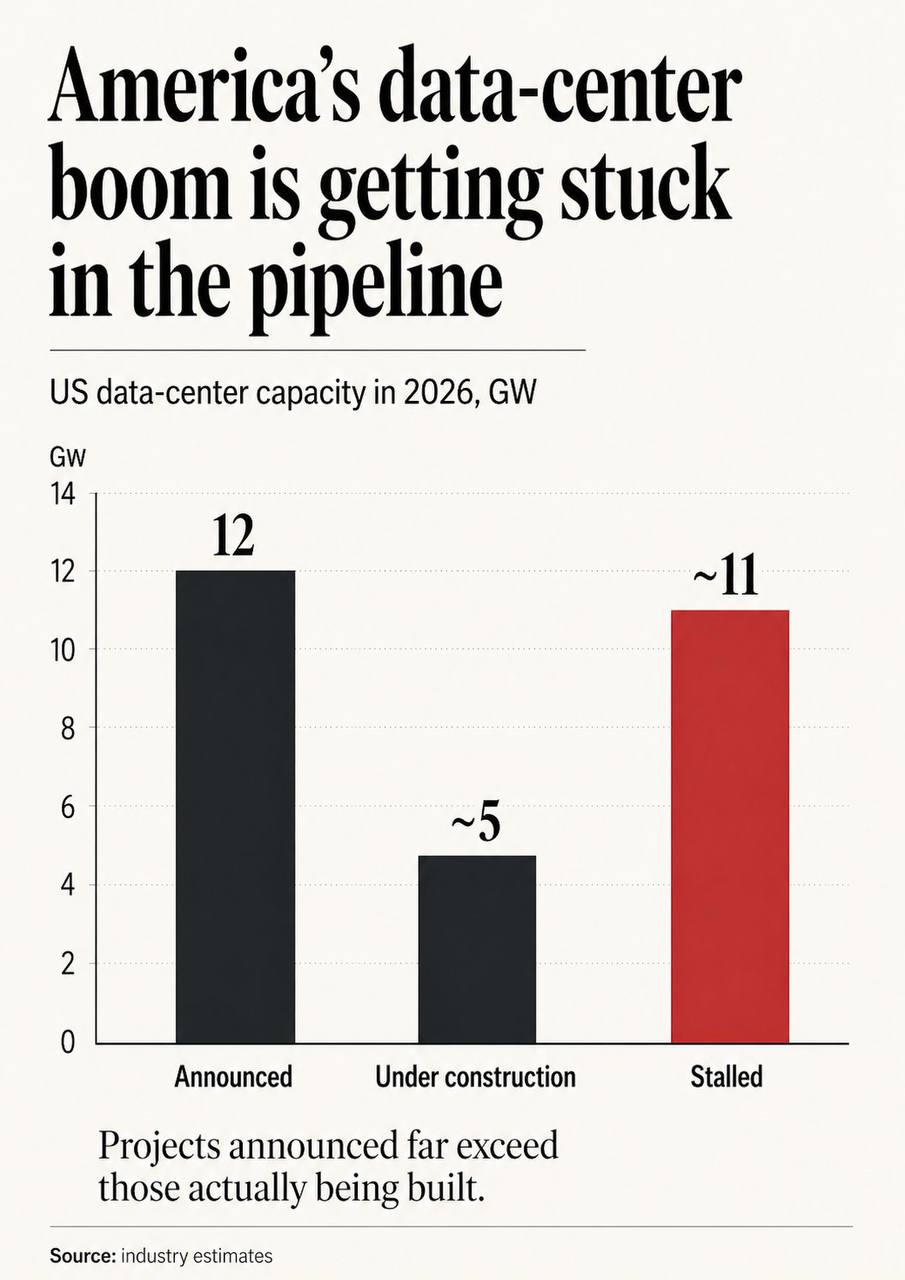
The gating equipment is specific: high-voltage transformers, switchgear, grid-tie batteries. Pre-2020 lead time on a high-power transformer was 24–30 months; today it's ~5 years. Electrical equipment is less than 10% of datacenter cost and 100% of the bottleneck. When a hyperscaler announces $50B of capex, the Street books it as compute online in 18 months — but if the transformer order wasn't placed in 2022, that money sits as commitment without capacity. You cannot pay for a transformer that doesn't exist. The winners under this regime locked PPAs and electrical-equipment orders 3–4 years ago; everyone else is in line. Meanwhile GPUs bought against stalled shells depreciate on NVIDIA's annual cadence while paying carrying costs — every dark quarter is compounding waste. The "six months from running out of compute" panic is really "five years from running out of transformers." Capital fixes one; capital cannot manufacture the other.
This also reframes the on-site generation stories. xAI's ~15 gas turbines in Memphis and OpenAI's gas-fired Stargate site aren't just labs bypassing the grid for speed — they're bypassing the transformer queue, which binds grid-tie regardless of generation source. And even that path has a cap: gas-turbine vanes have 12–18 month lead times with only three casting companies worldwide able to make them (Elon's own flag).
2. Power and interconnect generally. Substations take 4–7 years; transmission upgrades take longer; ERCOT, MISO, and PJM interconnect queues run multi-year. The US grid grows ~2%/yr against China's ~30%/yr, and China's electricity output is already roughly 2.3–2.4× the US. Whoever locks interconnect wins the decade. The nuclear-restart era — Three Mile Island for Microsoft, Palisades, a stack of SMR commitments — is happening with AI load as one of the main demand catalysts.
3. Lithography. The ~200 GW/yr ceiling from EUV throughput, above. This is the constraint that bites last but absolutely.
4. Memory. HBM3e/HBM4 capacity is sold out through 2027; ~30% of 2026 big-tech capex is going to memory (Dylan). The downstream effects reach consumer electronics: DRAM spot up ~3× ($3–4/GB → $12/GB), iPhone BOM up ~$250, smartphone unit projections collapsing from 1.4B toward 500–600M as HBM crowds out low/mid-end memory. New fabs don't land until late 2027/2028. This is the most under-covered second-order effect of the buildout.
5. People and water. Datacenter electricians, HVAC techs, and power engineers gate how fast a 1 GW facility gets wired. Liquid cooling is table stakes at GW scale, so site selection increasingly turns on water rights and ambient temperature.
The honest synthesis: Dario's 30–40 GW (2026) is what the curve does if the supply chain unblocks; Sightline's ~5 GW actually under US construction is the floor of what's physically in progress. The truth for 2026 lands between them, and the gap is measured in transformers.
The power seller's view
Everything above looks at the buildout from the compute buyer's side. Dan Dreyfus of Bornite Capital told the same story from the seller side — pitching Talen Energy at All-In's best-ideas competition (Liquidity Summit 2026) — and his grid-level numbers slot into this post's frame almost exactly.
The demand snapback is visible in plain grid data. US annual power demand growth by decade (Grid Strategies / EIA, from his slides):
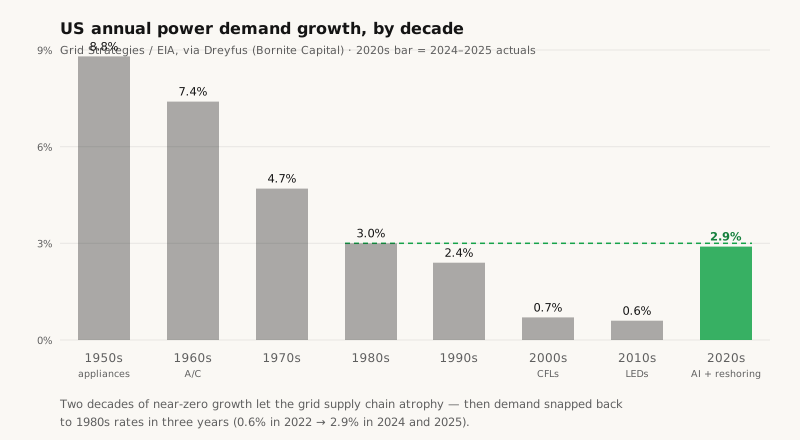
Two decades of effectively zero demand growth — efficiency gains plus offshoring the power-hungry industry (aluminum smelters and the like) to China — and the grid's supply chain atrophied to match. Then the 2020s: 0.6% (2022) → 0.9% (2023) → 2.9% (2024) → 2.9% (2025). Demand growth roughly quintupled in three years, back to 1980s rates. His sharpest framing: AI doesn't create the tight power market — "AI demand just turbocharges" a cycle that was turning anyway on electrification and manufacturing reshoring. Even with zero datacenters, the efficiency well was dry.
PJM is the case study. PJM's own 2026 long-term load forecast says the one grid region (Pennsylvania–Jersey–Maryland, where Talen operates 12 GW) needs 106 GW of gross new capacity over 10 years — 66 GW of demand growth plus 40 GW of scheduled thermal retirements. For scale, that's more than Japan's entire average power draw (~99 GW). One US grid region needs to add more than Japan consumes, in a sector where (his line) infrastructure happens in geological time. His two glosses: the coal "retirements" mostly won't happen ("we ain't retiring those coal plants"), and — the part that rhymes with the transformer thesis above — PJM's merchant power price is still too low to stimulate new capacity: "the math still doesn't work." The scarcity premium isn't showing up in the spot market; it's concentrated entirely in bilateral hyperscaler deals. Which brings us to:
The panic is measurable in the PPAs. His "Buyers Panic" slide — hyperscalers paying premium prices for decade-plus power contracts:
| Deal | Date | Size | Term | Pricing |
|---|---|---|---|---|
| Talen × AWS — Susquehanna nuclear plant, PA | Jun 2025 (expanded) | 1.92 GW of nuclear capacity | 17-year PPA through 2042 | Above-market; ~$18B contract value, full ramp by 2032 |
| Constellation × Microsoft — Three Mile Island Unit 1, PA | Sep 2024 | 835 MW — 100% of plant output | 20-year fixed offtake | Above-market; restart 2028 |
On the Three Mile Island economics, Dreyfus is specific: market power runs ~$50/MWh; Microsoft offered ~$100/MWh guaranteed for 20 years — a 2× premium to restart the reactor whose 1979 meltdown gave nuclear its 30-year bad name. This is the power-market twin of the ~$30M/MW Colossus desperation pricing above: when compute is the constraint, buyers pay 2–3× market on decade-long commitments and consider it cheap. The regulatory pushback is already here — "if you're taking all this power off the grid, how are we going to heat the homes?" — and his working compromise is the same one Google's 1 GW demand-response deal gestures at: sign the PPA, but force the datacenter to put batteries and peakers behind it to survive the few genuinely stressed hours a day.
A datacenter is a refinery. His commodities-investor translation: a refinery takes crude in and ships gasoline out; a datacenter takes electricity in and ships tokens out. Same shape — big capital-intensive box, "$50 billion per gigawatt," with power as the feedstock. That's a fourth independent arrival at the full-system number (after Cahn, Jensen, and Ball).
And the market values the refinery ~30× the power plant feeding it. Talen owns ~8 GW of baseload (2 GW nuclear + 6 GW gas) at a ~$25B enterprise value — roughly $3B of EV per GW of generation, against the ~$90B of EV per live GW the neoclouds command (CoreWeave/IREN, above) and below its own ~$45B replacement cost. The grid asset trades below what it would cost to rebuild, while the thing it feeds trades at multiples of it. That spread is either the buy signal Dreyfus is pitching, or a market verdict that nearly all the value accrues to compute over electrons — probably both. (Caveat on this whole section: it's a stock pitch from a fund manager long Talen. The slide data carries primary sources — PJM, EIA, Grid Strategies — but the Talen-specific math is an interested party's.)
The space wildcard
The most uncertain claim in the whole space is Elon's: ~100 GW/yr of AI in space within ~5 years, scaling toward ~1 TW/yr before fuel supply binds (Cheeky Pint). The arithmetic underneath: 100 GW to orbit ≈ ~10,000 Starship launches/yr ≈ one launch per hour with 20–30 reusable Starships; ~1M tons/yr to orbit at ~100 kW/ton payload density; SpaceX and Tesla both building toward 100 GW/yr of solar-cell production.
The unit economics are less crazy than they sound — energy is only 10–15% of datacenter TCO today, and solar in space runs ~5× ground efficiency (no atmosphere's ~30% loss, no day/night cycle), so the marginal dollar to launch isn't fighting the dominant cost line. The execution risk is everything else: SpaceX flew ~165 Falcon 9 launches in 2025, so one launch per hour is a ~50–60× cadence step-up on a vehicle that hasn't completed operational orbital cargo at scale; "20–30 reusable Starships" assumes Falcon-class reuse cycles not yet demonstrated; and 100 GW/yr of solar-cell production is no longer the whole global deployment rate, but it would still require internalizing ~15–20% of annual world solar manufacturing against recent global additions of >600 GW/yr.
Reasonable base case: a few GW/yr in space by 2030, not 100. Elon's number is a ceiling, not a forecast. Worth tracking, not pricing in.
The regulation wildcard
The space wildcard is a supply question. The next two are demand questions — and demand is what the whole buildout is borrowing against. The first one is a brake.
Every gigawatt in this post is underwritten by an unstated assumption: that the frontier model it serves stays deployable. That assumption is softer than the financing treats it. On June 12 2026, the US Commerce Department invoked national-security export controls to bar Anthropic from giving any foreign national — including foreign nationals inside the US, and its own foreign-national staff — access to its two most capable models, Fable 5 and Mythos 5. The directive was too broad to comply with selectively, so Anthropic disabled the models for everyone; only the less capable Claude Opus 4.8 stayed live. A frontier model — one whose safeguards tested stronger than anything previously shipped — went from released to dark in a day, by government directive, not by market.
That's the channel the capex curve doesn't price. The build is justified by demand pacing capability — but demand only shows up if the capability is allowed to diffuse. A government that can kill-switch the top model can also gate which models reach which markets, slow the release cadence the revenue curve assumes, or fragment the frontier along national lines. Any of those bends the AI-diffusion timeline, and the diffusion timeline is exactly what converts a gigawatt of installed compute into the ~$10B/yr that pays for it.
Base case: this is friction, not a wall. Export controls reroute demand more than they destroy it — the compute still gets used, often by the next model down. But it adds variance from a new direction. The buildout's load-bearing risk used to be purely economic (does the curve keep paying); a political variable now sits beside it (is the curve allowed to keep paying), and it's the one with the least historical data to underwrite.
The recursive self-improvement wildcard
The regulation wildcard is the demand brake. This is the demand accelerant — and it's the one that would make 250 GW look conservative.
Anthropic's framing of recursive self-improvement — AI systems capable enough to design and train their own successors — carries one line that matters more than the rest for this essay: in that regime, "the pace of progress in AI development becomes determined entirely by the availability of compute." Compute stops being one input among several (talent, data, ideas) and becomes the input. The trend lines underneath aren't hypothetical: Claude already authors over 80% of merged production code at Anthropic, the length of task a model can finish autonomously is doubling roughly every four months, and one code-optimization benchmark went from a ~3× speedup in May 2025 to ~52× by April 2026.
If that curve holds, compute allocation flips from a cost center into the rate-limiter on intelligence itself — and the rational response to a rate-limiter is to buy all of it you can. Every lab in the per-lab table is already racing for inference capacity to serve today's demand; an RSI regime stacks a second, larger claim on the same gigawatts, because training the successor becomes a compute-bound race where being one generation ahead compounds. That's the scenario where Dario's 300 GW in 2029 stops looking like it overshoots Dylan's ASML ceiling and starts looking like the reason someone tries to break it.
Base case: unproven, and Anthropic is explicit that RSI is "not inevitable" and that it's "genuinely unclear whether today's training methods and architectures could unlock that capacity." But it's the asymmetric bet sitting under the whole buildout. If it doesn't arrive, the curve flattens and the impairment case below applies. If it does, no published GW forecast is high enough — and the transformer queue, not capital or ambition, decides who's standing in the right place when it hits.
What breaks it, and what it means
The demand side, so far, is keeping up. The open question that looked scariest a year ago — does revenue accelerate fast enough to justify the curve — looks provisionally answered by the Opus 4.5 capabilities jump and the step-up in Anthropic revenue that followed ($1B → ~$9–10B in 2025, another few billion added in January 2026 alone, targeting 20–30×/yr growth). Dylan's framing makes the coupling explicit: if Anthropic adds another $60B of revenue in ten months, it needs ~4 GW of incremental inference capacity just to serve the growth. Demand is pacing capex — for now.
But the structural risks compound:
- If scaling laws plateau, the impairment cycle is historic. $568B/yr of Mag 5 capex assumes the curve keeps paying. If returns flatten before 2028–29, the write-downs are bigger than telecom dark fiber, bigger than 1999.
- Labs without hyperscaler parents carry infrastructure risk that's hard to underwrite. Anthropic's ~$20B ARR implies someone laid out ~$50B of capex for them. xAI more so. If revenue growth misses, the impairment lands somewhere — and it's not obvious where.
- Concentration risk is systemic. NVIDIA on track to control >70% of N3 wafer capacity by 2027. Three turbine-casting companies. One country refining ~98% of gallium. One EUV supplier whose entire ecosystem is ~10,000 people. Any single-point failure is a systemic event.
- Attribution and sustainable funding matter more, not less. The next decade of AI economics has to amortize against $3–7.5T of capex. The bigger the bill, the worse a bad attribution model gets.
What I actually believe
Having walked all of it — the trajectory math, the cost lenses, the financing instruments, the bottleneck rankings — here's where I land.
The build is real, and it lands somewhere near 250 GW by 2030. Not the 700 GW you get by summing the aspiration curves, and nothing like a stall — the realistic ladder's ~220–300 GW, doubling every eighteen months. Compute keeps tripling anyway, because chip efficiency carries the difference. Every independent check in this post — the grid data, the capex arithmetic, the chip supply — points at the same landing zone.
Transformers are the real clock. Not capital: the largest balance sheets in the world are already committed. Not chips: the EUV ceiling doesn't bind until ~200 GW a year. A five-year queue for high-voltage transformers decides which announced gigawatts become live ones, and the winners were decided years ago, when somebody did or didn't place an electrical-equipment order. Capital can buy chips; it cannot manufacture time.
And the equity is the risky layer, not the infrastructure. That's the railroad precedent read correctly: the rails compounded for a century while a generation of investors got wiped out, and telecom's dark fiber carried the internet after the equity went to zero. If scaling returns flatten, the write-downs will be historic — but the gigawatts, substations, and interconnects stay built and get used. Whichever way the AI bet resolves, the country comes out the other side with the power grid it should have started building a decade ago.
This essay started as raw notes on BG2, Dwarkesh, 20VC, All-In, and Cheeky Pint episodes; the per-source notes live in the appendix below. Updated September 2026 against the Dwarkesh × Dylan Patel follow-up.
Where sources diverge
The headline numbers in this post come from people measuring different things. The biggest disagreements, and what to read into them:
| Metric | Year | Sources & figures | Spread |
|---|---|---|---|
| Industry GW (built / stock / incremental) | 2025 | Dario 10–15 GW built · Dylan ~20 GW US incremental · Elon 20–25 GW world stock · BG2 ~60 GW total (incl. replacement) | 4–6× depending on lens |
| Industry GW path | 2029–30 | Dario ~300 GW (2029) · Dylan ~200 GW ASML ceiling (2030) · Sam ~52 GW/yr target · Ball ~150 GW cumulative new by 2030 · Dylan (Aug 2026) ~200 GW global stock by end 2028 (+30/+50/+70/+90–100) | Dario > physical ceiling; Aug-2026 path is above this post's realistic ladder |
| US additions, scheduled vs realized | 2026–27 | Goldman/Aterio scheduled 13.6 / 36.3 GW · historically ~72% on time, risk-adjusted ~60% / ~50% materialize | ~2× announce-vs-build gap |
| Cost per GW | — | Dario $10–15B · Cahn $40B · Jensen $50–60B · Ball ~$50B · Chamath project escalated $4–5B → $50B | 4–5× spread |
| Chip share of a full-system GW | — | Ball ~70% of $50B (~$35B) for chips/compute · Dario $10–15B silicon-only | 2–3×; systems-at-market-price vs. bare silicon |
| Mag-N / Big-N capex | 2026 | BG2 Mag 5 $379–450B · Dylan Big-4 ~$600B (+ ~$1T full ecosystem) | 1.5–2× (different scopes) |
| Mag-N / Big-N capex | 2028 | BG2 Mag 5 $535B · Dario industry $1.0–1.5T/yr | 2–3× (different scopes) |
| Revenue per live GW | — | Dylan (earlier) ~$10B/yr rental · Frier ~$10B · SpaceX S-1 implies Anthropic paying ~$30M/MW (~3× comps) · Dylan (Aug 2026) lab revenue as high as $50M/MW, end-revenue $100B/GW, most compute still transacts sub-$20B/GW | 5–10× rental vs. lab-earned |
| NVIDIA revenue | this yr | Dylan ~$160B · BG2 ~$200B | ~25% |
| NVIDIA revenue | 2030 | Dylan $350–400B · BG2 ~$350B | converge within ~10% |
| China power vs US | today | Elon ~2.3–2.4× (electricity output) · Dreyfus ~3× (generation capacity) | output vs nameplate capacity — China's huge solar fleet inflates capacity more than output |
What to read into this:
- GW numbers aren't comparable without a denominator. "World stock" (Elon, 20–25), "US incremental" (Dylan, ~20), "industry-built that year" (Dario, 10–15), and "total normalized incl. replacement" (BG2, ~60) are four different metrics. Any single GW headline without the lens is hand-waving.
- Cost per GW depends on what you count. Dario's $10–15B is silicon-only. Cahn's $40B, Jensen's $50–60B, and Ball's $50B include the powered shell, networking, and next-gen silicon. Chamath's $4–5B → $50B is the same delta in motion on one project. The chip-share row is the only live disagreement.
- Dario's 2029 path breaks Dylan's ASML ceiling. 300 GW > 200 GW hard cap. They can't all be right.
- The capex scopes nest (BG2 Mag 5 ⊂ Dylan Big-4 ⊂ Dario industry), so those aren't contradictions. The shape they agree on: steep through 2026, flattening after 2028.
Appendix: source notes — casual readers, you're done. Expand for the raw per-source notes the essay is built from.
The raw, per-source notes the essay above is built from. Kept verbatim for reference-chasing; half-life on accuracy is short.
The capex curve (BG2 chart)
The BG2 "$3 Trillion CapEx: Are We Overbuilding AI?" segment, Oct 14 2025 — Mag 5 capex vs. operating cash flow, 2015 → 2030E:
- 2015: $25B capex (~27% of OCF)
- 2020: $97B (~38%)
- 2024: $241B (~50%)
- 2026E: $450B (~66%)
- 2028E: $535B (~71%)
- 2030E: $568B (~75%)
Big lab compute footprints (current)
Numbers here are rough — half from press, half from podcasts.
OpenAI / Stargate (via Microsoft + Stargate LLC)
- End of 2025: ~2 GW of operational compute capacity (≈ output of 2 average nuclear plants).
- Multi-site, headline ~10 GW total commitment, Abilene TX as anchor, Oracle as compute partner, Microsoft no longer exclusive.
- Bloomberg / SoftBank-Stargate: 10 GW center described by Son + Trump officials would be among the largest in the world. Site = former uranium enrichment complex owned by US Energy Department. Powered by ~$33B of natural-gas-fired electricity.
- Vast majority of compute reportedly signed on five-year deals.
- Incremental added compute is where cost explodes.
- Dylan Patel: "OpenAI went from 600 MW to 2 GW last year, 2 GW → 6+ GW this year, 6 → 12 GW next year." [Dwarkesh × Dylan Patel, ch. "ASML constraint" 34:34]
- Sam wants 50 GW.
- Stated 30 GW by 2030 (OpenAI Newsroom).
xAI / Colossus (Grok)
- Memphis, TN. Rapid local infra build. Scaled to ~200K H100s in record time, on-site gas turbines because the grid couldn't deliver.
- Approval for 300 MW (0.3 GW) from Tennessee Valley Authority.
- ~15 mini gas turbines on-site, hundreds of additional MW.
- Second facility underway, third building purchased.
- Plan: total power needs across Memphis region → 2 GW.
- Colossus 2 reportedly targeting 1M+ GPUs.
- Per the SpaceX S-1 (via Ball): SpaceX (post-xAI acquisition) rents Colossus capacity to Anthropic at ~$15B/yr for ~500 MW (Colossus 1 ~300 MW + assumed ~40% of Colossus 2's operational ~500 MW) — ~$30M/MW vs. $10–12M/MW neocloud comps, with a 90-day out clause. Cursor also has announced capacity. SpaceX's full-year 2025 revenue was $18.7B; the Anthropic deal alone nearly matches it.
Anthropic / AWS Project Rainier
- Doesn't build its own physical datacenters — secures cloud compute from Google + AWS.
- Trainium2 cluster, multi-site, "hundreds of thousands" of accelerators. Anthropic's Claude training stack.
- 1 GW of compute coming online in 2026 via Google Cloud agreement.
- Just signed massive expansion with Broadcom + Google: another 3.5 GW of Google TPU capacity starting 2027.
- Total secured footprint: ~4.5 GW over the next year or two.
- Dylan Patel: Anthropic needs to get well above 5 GW by end of this year (tough but possible).
- Anthropic ARR ~$20B. Margins sub-50% (per Information). → ~$13–14B compute rental → ~$50B of CapEx someone laid out for them.
Meta / Hyperion + Prometheus
- Louisiana (Hyperion, ~2 GW), Ohio (Prometheus). Zuck has been public about multi-GW build commitments.
- Total global capacity arguably the largest of the group, dozens of datacenters worldwide. Distributed across existing hyperscale footprint, TPU-heavy, less single-site headline-grabbing but probably the largest aggregate.
- Don't publicly separate AI vs. cloud GW.
- Accounted for a large chunk of the 20+ GW of corporate clean-power agreements signed by big tech in 2025.
- Early 2026: signed 1 GW of capacity just for demand response — enough AI workloads to dial back 1 GW to stabilize local grids.
Microsoft (Satya, 2025)
- Wisconsin, plus the OpenAI co-located footprint pre-Stargate.
- "Just last year, we added over 2 gigawatts of new capacity — roughly the output of 2 nuclear power plants."
- Reportedly stepping back from some leases as OpenAI diversifies.
Cost / unit economics
David Cahn @ Sequoia, 20VC, Oct 27 2025
- "Sam Altman now talks about gigawatts every day. He's not talking about dollars anymore… we're moving away from dollars and we're moving toward gigawatts." [20VC, "Physical Data Centres is a Moat" 5:04]
- Rough math: 1 GW = $40B to build out.
- Jensen: $50–60B with Vera Rubin.
- 100 GW buildout (what people are talking about now) = AI's $8 trillion question.
- 250 GW = AI's $20 trillion question.
Jamin Ball, Clouded Judgement 5.22.26 — The Neocloud Boom
- ~$50B total cost to build 1 GW (Blackwell-dominated): ~70% chips/compute (50% GPUs, 10% networking, 5% CPUs, 3% storage, 2% assembly), ~20% shell + power infra, ~5% cooling, ~5% land/permitting/other.
- ~150 GW of new capacity in next 4.5 years (from OpenAI 30 GW by 2030 + Anthropic assumed similar = ~55 GW, at 30–40% share of new builds).
- $50B × 150 GW = $7.5T total ≈ $1.7T/yr ≈ 5% of US GDP (~$32T).
- Historical precedents: railroads 1880s ~6% of GDP, telecom early 2000s ~1.2%, Manhattan Project ~0.4%.
- ~$90B enterprise value per live GW (CoreWeave, IREN; Nebius higher). 150 GW × $90B = $13.5T implied EV creation; ~20% neocloud capture ≈ $2.5T+.
- CoreWeave ~6× NTM revenue, Nebius/IREN ~10×; EBITDA: CoreWeave ~10×, IREN/Nebius ~20×.
- Neocloud market structure prediction: a handful of very large players + long tail incl. single-site independents, like the IPP market; PE plays a big role.
- SpaceX S-1: Anthropic paying ~$15B/yr for ~500 MW of Colossus (~$30M/MW vs. $10–12M/MW comps; CoreWeave's guidance implies ~$11M/MW), 90-day out clause.
Jaime Sevilla (@sevillamol), Jan 5
- "Bitcoin arguably has much more compute power than Google" — disputes this.
- Bitcoin hashing infra worldwide ≈ $30B ≈ same as cost of one 1 GW AI datacenter.
- Google produced and installed TPUs worth more just in 2025 Q3.
Chamath
- Greenlit a project he thought was $4–5B → went to $10B → $15B → $20B → upwards of $50B for the powered shell, land, permits, infrastructure, people, all of it.
- Sarah Frier (~year ago): every gigawatt is about $10B in revenue.
Dylan Patel (SemiAnalysis) on Dwarkesh
Source: Dwarkesh × Dylan Patel — full episode. Chapters: H100 economics 0:00 · ASML constraint 34:34 · Memory crunch 1:16:01 · Power scaling 1:42:34.
- Big 4 (Amazon, Meta, Google, Microsoft) combined forecasted capex this year ≈ $600B.
- At yearly rental prices, that's close to 50 GW of compute (but not all delivered this year).
- ~20 GW incrementally added in America this year.
- Across rest of supply chain → ~$1T total.
- Big chunk of capex is for future years: turbine deposits for '28/'29, datacenter construction for '27, PPAs, down payments.
- Anthropic + OpenAI today: ~2 GW / 2.5 GW / 1.5 GW range.
- If Anthropic adds another $60B revenue across next 10 months at current gross margins → ~$40B compute spend → at $10B/GW rental → need 4 GW of inference capacity just to grow revenue (R&D fleet flat).
- H100 prices have inflected up significantly: [H100 economics 0:00]
- Some labs signing 2–3 year deals at as high as $2.40/hr for H100s.
- vs. ~$1.40/hr build cost across 5 years → much higher margins.
- TCO buildup: datacenter cost + networking + smart hands + spares + chip + server + depreciation + credit costs.
- H100 ≈ $1.40/hr deployed at volume across 5 years.
- Sign at $2/hr for 5 years → ~35% gross margin.
- Why an H100 is worth more today than 3 years ago: GPT-5.4 generates more tokens per GPU than GPT-4, of higher quality. TAM of GPT-4 tokens = few billion → tens of billions. GPT-5.4 → north of $100B (with adoption lag + competition).
- "An H100… can repay itself in the couple of months" if it's producing value close to a human.
- Companies with locked-in 5-year contracts have humongous margin advantage vs. those buying at modern pricing.
- The incremental compute is where all the cost is — not the long-term contracts.
- Infra providers hold the card on margin.
- TSMC ecosystem: 250–300 EUV tools today + ~70 added this year + ~80 next + → ~700 by end of decade. [ASML constraint 34:34]
- 3.5 EUV tools per GW (if all allocated to AI) → ~200 GW of AI chips by 2030 (hard upper bound).
- Sam Altman wants ~52 GW/yr — i.e. ~25% of that 2030 ceiling.
- OpenAI exited last year ~2 GW. Anthropic will get to 2+ GW this year. By end of next year, both ≈ 10 GW capacity.
- China hasn't done this. If/when Anthropic 10x's revenue again, China doesn't have the compute.
- 30% of big-tech capex in 2026 going to memory. [Memory crunch 1:16:01]
Per-hyperscaler capex (this year → next): [~1:05:37]
- Google: $180B → $300B.
- Amazon: ~$200B.
- NVIDIA revenue: ~$160B/yr (~$40B/qtr).
Recent lab raises: OpenAI just raised $110B; Anthropic just raised $30B. Anthropic adding $4–6B revenue/month.
TSMC capex: $30B + $30B + $40B = ~$100B over 3 years.
Dylan Patel on Dwarkesh — Aug 25 2026 follow-up
Source: Dwarkesh × Dylan Patel — "Anthropic & OpenAI will have most of the world's compute by 2028" (dwarkesh.com). Transcript-checked 2026-09-01. "This year" = 2026.
- Capex: "a little over a trillion dollars" this year; more than $2T in 2028. Labs go tens of billions → hundreds of billions → contracts pointing at trillions/yr late decade.
- Anthropic profitable in Q2 2026; OpenAI believed capable in Q3 on Codex + GPT-5.6. More of the build now funded off lab revenue, not venture.
- Compute cost still $10–15M/MW. GPT-4 on Hopper was negative GM; GPT-5.6 / Opus 5 / Fable 5 clear well past cost. Anthropic revenue as high as $50M/MW. End-revenue for a GW of chips: $100B. End-2027 lab revenue $50M+/MW, $70–80M/MW blended on the table.
- OpenAI started 2026 at 2 GW, Anthropic <2 GW; both above 5 GW by end 2026 (3–4×). ~30% of 2026 incremental compute is for the two labs; 40–50% next year; half of incremental by end 2027. 3× path: 2 → ~6 → 18 (end 2027) → 54 (end 2028) per lab, ~100 GW combined, 70–80% of incremental.
- World incremental: +30 GW (2026), +50 (2027), ~+70 (2028), +90–100 (2029) → ~200 GW global by end 2028. ~80 GW in 2028 is the bullish upper bound. World GW doubles every year; GB300 / TPU v7 / Trainium 3 are 3–5× prior-gen performance per watt.
- SpaceX is the new lessor (~$40B/GW to Google, ~$50B/GW to Anthropic). OpenAI building own chips; Anthropic buying Google TPUs, deploying with Fluidstack. Most compute still transacts sub-$20B/GW because it has to be financed; Meta and SpaceX can build without a customer and then sell.
- $6B fab capex produces 1 GW of chips every year. 100 ASML tools/year still the 2030 number; Zeiss now believes they need enough mirrors for that, didn't earlier this year.
- China: sub-10% of incremental AI watts; ≤30 GW by 2028; 50 GW of worse domestic chips in 2029 "completely reasonable." Leading Chinese labs 100–200 MW (ByteDance Seed outlier) vs Anthropic >5 GW by year-end.
- If 100 GW/year: ~$5T IT capex, $7–10T all-in (shells + power plants bought years ahead) → approaching a quarter of the US economy. Anthropic willing to pay 20% rates because it still beats renting from SpaceX at $50B/GW.
- Regulation is already biting unit economics: best model in the world trained in February; Mythos not out; OpenAI paused training two weeks. If labs can't ship their best models, $/MW stalls and they can't outbid for 100 GW.
Per-GW silicon recipe (back-of-envelope from Dylan):
- ~55,000 wafers of 3nm + ~6,000 of 5nm + ~170,000 of DRAM per GW of AI capacity.
- ~2M EUV passes per GW (~1.1M for logic alone).
- EUV tool ≈ $300–400M × 3.5 tools = ~$1.2B per GW just in litho.
- NVIDIA on track to control >70% of N3 wafer capacity by 2027.
- ASML supply chain ≈ 10,000 people worldwide.
Memory crunch downstream effects: [1:16:01]
- DRAM spot: $3–4/GB → $12/GB (≈3x).
- iPhone memory cost: $50 → $150 (+$100); total iPhone BOM up ~$250.
- Smartphone unit projections crash from 1.4B → 1.1B → 800M → 500–600M as HBM crowd-out gutters the low/mid-end.
- New memory fabs don't come online until late 2027 / 2028.
Power-growth gap (China): [Power scaling 1:42:34]
- US grid: ~2% power growth/yr vs. China ~30%/yr.
- Amazon's fastest datacenter build start-to-online: ~8 months (vs. 2–3 yrs typical).
Dario (Dwarkesh)
Source: Dwarkesh × Dario Amodei — "We are near the end of the exponential". The compute-trajectory quote is in chapter "If AGI is imminent, why not buy more compute?" 46:20.
- Industry building this year: ~10–15 GW.
- Going up roughly 3x/yr.
- 2026: 30–40 GW
- 2028: ~100 GW
- 2029: ~300 GW
- Each GW ≈ $10–15B → multiple trillions/yr by 2028–29.
- (Mine, not Dario's:) If Anthropic compute keeps 3x'ing → by 2027–28 you have 10 GW × $10B = $100B/yr.
Anthropic revenue ladder + economics [~12:36 + ~58:49]:
- 2023: $0 → $100M. 2024: $100M → $1B. 2025: $1B → ~$9–10B. Jan 2026 alone added "another few billion."
- Targeting 20–30x/yr growth (vs. current ~10x).
- Compute split: roughly 50/50 train vs. inference today; inference gross margin >50%.
- Profitability target: ~2028.
- Headcount: ~2,500 people.
- Computer-use benchmark (OSWorld): ~15% → 65–70% in a year.
- Macro: Dario expects 10–20% real GDP growth/yr post-AGI — vs. compute itself growing ~300%/yr. (i.e. compute outruns the economy that's supposed to absorb it.)
Elon (Cheeky Pint w/ John Collison + Dwarkesh, Feb 5 2026) — AI in space
Source: Cheeky Pint Ep. 21 — full episode. Most quotes here come from chapter "Space GPUs" 0:23; some recur in "Space GPUs redux" 2:34:58.
- Expects "at least, five years from now, a few hundred gigawatts per year of AI in space and rising."
- Can get to ~1 terawatt/yr of AI in space before fuel-supply challenges.
- "100 GW… distributed power…"
- "The actual peak power production in the US is over 1,000 gigawatts. But the average power usage… is 500" (day–night cycle).
- Charging at night → incremental ~500 GW available.
- Tesla edge compute: not constrained.
- Once power constraint is unlocked → hundreds of GW/yr in space.
- Launching ~200 GW/yr to space ≈ lapping all US electricity production every 2.5 years.
- Server-side concentrated compute constraint between now and then = electricity.
- "The world has maybe 20, 25 gigawatts of compute" today.
- To get to a terawatt of logic by 2030 → need very big chip fabs.
- "Every 110,000 GB300s" ≈ ~300 MW raw, scaling to ~1 GW once you add cooling, networking, and service margin.
- Both SpaceX and Tesla building toward 100 GW/yr of solar cell production.
Space-GPU unit economics (the part that actually makes this less crazy):
- Energy is only ~10–15% of datacenter TCO today — i.e. the marginal $ to launch isn't fighting the dominant cost line.
- Solar in space: ~5x ground efficiency; atmosphere costs ~30% loss + day/night cycle.
- Solar cells in China today: $0.25–0.30/W.
- 100 GW to orbit ≈ ~10,000 Starship launches/yr ≈ 1 launch/hour, doable with 20–30 reusable Starships.
- Logistics target: ~1M tons/yr to orbit in 3–4 years, at ~100 kW/ton payload density.
- Cooling overhead in space adds ~40% to power; servicing reserve adds 20–25%.
- Ground equivalent: 1 TW solar = 4 TW of panels at 25% capacity factor ≈ ~1% of US land area.
Industrial bottlenecks Elon flagged:
- Gas-turbine vanes/blades have 12–18 month lead times, with only 3 casting companies worldwide capable of making them — a hard cap on how fast on-site gas generation can scale.
- China accounts for ~98–99% of primary low-purity gallium production/refining.
- China's electricity output is currently closer to ~2.3–2.4× US output, not 3× yet, though the gap is still widening.
Total Musk-co headcount (Tesla + SpaceX + xAI + …): ~200,000 people — for context on the labor scale of any 100 GW/yr ambition.
BG2 Pod, Oct 14 2025 — "$3 Trillion CapEx: Are We Overbuilding AI?"
Source: BG2 — "AI Bubble, Stablecoin Boom, and Runnin' Down a Dream". Relevant chapters: "The AI CapEx Bubble?" 7:00 · "$3 Trillion CapEx: Are We Overbuilding AI?" 19:15 · "MAG5 CapEx Surge" 21:45 · "OpenAI's Race for Escape Velocity" 25:30.
- Headline framing for the episode: ~$3 trillion in total AI capex is what the industry is trying to absorb in this cycle. Useful watchposts in the same ep: "Sham vs. Real Transactions in AI" 9:30, "Microsoft–OpenAI Credits & Cloud Economics" 11:00, "CoreWeave, Hidden Leverage & Demand Risks" 17:00 — the round-tripping concern lives here.
- Normalizing everything to GW of datacenter: ~60 GW total. Not all incremental — a lot is replacement/upgrade.
- NVIDIA sellside revenue forecast: $200B this year → $350B in 5 years.
- This year: ~4–5 GW of compute sold (most incremental). Grows to ~9 GW by 2029/30.
- $350B / $400B = NVIDIA consensus revenue.
- 2023 total capex: $156B → 2026: $379B. Radical step-up.
- OpenAI on the hook for ~$150B capex in 2030. [OpenAI's Race for Escape Velocity 25:30]
- Would need ≥ $150B of revenue to justify it. Plausible.
Kobeissi Letter, Oct 28 2025
- US has 5,426 datacenters — more than ALL other major countries combined.
- US has 10x more datacenters than Germany (#2 country).
Aakash Gupta on the transformer bottleneck (Sightline Climate data)
[Source: Aakash Gupta on X]. Direct evidence for the "power not GPUs" thesis — and worse than I'd been pricing in. Sightline Climate's 140-project tracker shows the announced-vs-built gap is now ~50% on 2026 capacity, with grid transformers (not silicon, not permits) as the active bottleneck.
The Sightline Climate numbers (2026 US capacity, 140 projects tracked):
- 12 GW announced across 140 projects (planned 2026 capacity, not yet breaking ground).
- ~11 GW of that 12 GW is stalled in the "announced" stage with no physical progress, despite typical build times of 12–18 months. (Subset of the 12 GW above — not a parallel bucket.)
- ~5 GW separately under construction (i.e. projects that have moved past announced and are physically being built; this is a different denominator from the 12 GW announced bucket).
- 25% of announced projects haven't disclosed a power strategy at all — i.e. a quarter of "planned 2026 AI capacity" has no sourced answer to where the electrons come from.
The actual gating constraint — high-voltage transformers, switchgear, grid-tie batteries:
- Pre-2020 lead time on a high-power transformer: 24–30 months.
- Today: ~5 years.
- Electrical equipment is <10% of total datacenter cost — and 100% of the bottleneck.
Dan Dreyfus (Bornite Capital) — Talen Energy pitch @ All-In Liquidity Summit
Source: All-In — "Best Ideas Pitch Competition", Dreyfus segment from 13:09. Slide data transcribed from the stream; quotes checked against the YouTube transcript.
Power Cycles slide (sources on slide: Grid Strategies "Strategic Industries Surging: Driving U.S. Power Demand", Dec 2024; EIA Electric Power Monthly) — US annual power demand growth by decade:
- 1950s (appliances): 8.8% · 1960s (air conditioning): 7.4% · 1970s: 4.7% · 1980s: 3.0% · 1990s: 2.4% · 2000s (CFLs): 0.7% · 2010s (LEDs): 0.6%
- 2020s (AI/datacenters): 2022 0.6% → 2023 0.9% → 2024 2.9% → 2025 2.9%. Slide callout: load growth accelerating on datacenters/AI + electrification + manufacturing reshoring.
- Narrative: power demand normally tracks GDP; tech breakthroughs spike it; efficiency phases suppress it. The 2000s–2010s were a double suppression — LED/HVAC efficiency plus offshoring smelter-class load to China. "We do not need AI demand to keep the power markets incredibly tight for the next 20 years. AI demand just turbocharges."
PJM Capacity Forecast slide (sources on slide: PJM 2026 Long-Term Load Forecast, Jan 2026; PJM 2025 Regional Transmission Expansion Plan, Apr 2026; OCCTO Japan FY2024; IEA World Energy Investment 2025):
- PJM gross new capacity needed over 10 years: 106 GW = 66 GW demand growth + 40 GW thermal retirements.
- Comparison bar: Japan's entire average power consumption ≈ 99 GW.
- Talen has 12 GW of operating capacity in PJM.
- Color: "We ain't retiring those coal plants"; 10 years to build 106 GW is "geological time"; PJM power prices are still too low to stimulate new capacity — "the math still doesn't work."
Buyers Panic slide (hyperscalers paying premium prices for decade-plus power contracts):
- Talen × AWS, Jun 2025 (expanded): Susquehanna nuclear plant, PA — 1.92 GW nuclear capacity, 17-year PPA through 2042, above-market pricing, $18B contract value, full ramp by 2032.
- Constellation × Microsoft, Sep 2024: Three Mile Island Unit 1, PA — 835 MW = 100% of plant output, 20-year fixed offtake, above-market pricing, restarting 2028.
- Dreyfus on TMI: power ~$50/MWh; Microsoft offered ~$100/MWh minimum for 20 years to trigger the restart. "Three Mile Island, brought to you by Microsoft Azure."
The Talen pitch itself (interested party — he's long):
- Talen: ~2 GW nuclear + ~6 GW natural-gas baseload; ~$25B EV vs. ~$45B replacement cost → equity more than a double just to reach replacement (Sam Zell playbook: buy hard assets below replacement cost ahead of a capacity-build cycle).
- Scenarios: do nothing → ~$50/share FCF (stock high-$300s ≈ 7× FCF vs. ~15× for US infrastructure); more premium datacenter PPAs → ~$70/share; build ~4 GW of new capacity → $100+/share.
- 15× as a blended multiple: contracted PPA cash flows are bond-like (20×+), merchant/spot exposure trades lower; more contracted EBITDA → higher multiple.
- Other claims: datacenter = refinery, electricity in / tokens out, $50B per GW; "copy China" — US started the cycle at 2× China's generation, China now ~3× US (capacity lens); Jensen "we need 1,000× more power"; nickel superalloys + silver + critical minerals shared across power plants, rockets, and PV = shortages of everything; regulatory fix = PPA + batteries + peakers behind the meter; fuel cells / Caterpillar turbines as high-LCOE bridge ("you don't give a crap what you pay for the bridge" when a $50B datacenter would otherwise sit idle 3 years).
Goldman Sachs / Aterio — realized vs scheduled US additions
Source: Goldman Sachs Research — "US data center power demand projected to double by 2027" (Wei, Struyven, Dart; Aterio facility-level activation data: locations, permitting, construction status, satellite imagery).
- US datacenter capacity additions realized: 6.4 GW (2024) → 8.5 GW (2025).
- Scheduled: 13.6 GW (2026) → 36.3 GW (2027).
- Historically only ~72% of capacity scheduled within the next four quarters activates on time; Goldman risk-adjusts to ~60% materializing on a one-year view, ~50% on two.
- Q1 2026 realized: 2.2 GW; risk-adjusted remainder of 2026: ~11.5 GW.
- Causes of slippage: developers file multiple regions and build one; supply chain + labor shortages; 18–24-month build once permits land.
- Regional: 2027 scheduled additions in Mid-Atlantic, Texas, and Mid-Continent each exceed the entire nation's 2025 additions; reliability risk concentrated in Mid-Atlantic / Mid-Continent / Northwest; Texas + Georgia have generation pipeline to absorb.
Epoch AI — chip efficiency trend
Source: Epoch AI — "Trends in machine learning hardware" (47 ML accelerators 2010–2023 + 1,948 GPUs).
- Energy efficiency (FLOP/s per watt, FP32): 2× every ~3.0 years for ML GPUs (~1.26×/yr).
- Computational performance (FLOP/s): 2× every ~2.3 years; price-performance (FLOP/$): 2× every ~2.1 years.
- Lower-precision formats + tensor cores give order-of-magnitude jumps on top (tensor-FP16 ≈ 10× FP32 throughput).
- Memory wall: capacity 2× every ~4 yrs, bandwidth 2× every ~4.1 yrs — both slower than compute.
SemiAnalysis — AI datacenter energy model (Mar 2024)
Source: SemiAnalysis — "AI Datacenter Energy Dilemma" (3,500+ North American datacenters tracked + accelerator-model power demand; free half).
- Global datacenter critical IT power: 49 GW (2023) → 96 GW (2026), of which AI ~40 GW by 2026; AI crossing 10 GW in early 2025.
- Datacenter capacity growth accelerating from 12–15% CAGR to ~25% CAGR.
- Total AI compute capacity (peak FP8 FLOPS) grew 50–60% per quarter since 1Q23 — i.e. compute compounds much faster than power, the efficiency wedge in action.
- AI at ~4.5% of global energy generation by 2030 on their path (vs. doomsday 24% scenarios).
- Critical IT power ≠ grid draw: worked example, 20,480 H100s ≈ 28.4 MW critical IT ≈ 28–29 MW average grid draw at 80% utilization × 1.25 PUE.
Sources
Primary podcasts (with YouTube + chapter timestamps inline above):
- Elon Musk on Cheeky Pint w/ John Collison + Dwarkesh Patel, Feb 5 2026
- Dario Amodei on Dwarkesh Podcast — "We are near the end of the exponential"
- Dylan Patel (SemiAnalysis) on Dwarkesh Podcast — 3 big bottlenecks
- Dylan Patel on Dwarkesh Podcast — "Anthropic & OpenAI will have most of the world's compute by 2028", Aug 25 2026
- David Cahn (Sequoia) on 20VC, Oct 27 2025
- BG2 — "AI Bubble, Stablecoin Boom, and Runnin' Down a Dream", Oct 14 2025
- All-In — "Best Ideas Pitch Competition" (Liquidity Summit 2026), Dan Dreyfus / Bornite Capital on Talen Energy from 13:09
Written:
- Jamin Ball — Clouded Judgement 5.22.26: The Neocloud Boom (cost decomposition, 150 GW path, %-of-GDP precedents, EV-per-GW yardstick, SpaceX/Anthropic S-1 math)
- Goldman Sachs Research — US datacenter power demand projected to double by 2027 (realized vs scheduled US additions, ~50–60% materialization rates — the realistic-ladder grid evidence)
- SemiAnalysis — AI Datacenter Energy Dilemma (AI critical IT power model: 10 GW early 2025 → ~40 GW 2026; compute-vs-power wedge)
- Epoch AI — Trends in machine learning hardware (FLOP/s-per-watt doubling every ~3 years — why compute outruns gigawatts)
Other:
- Is AI Profitable Yet? — per-company cumulative AI spend vs. revenue tracker (May 2026 snapshot); independently cross-checks the Big-4 burn rate (~$620B/yr ≈ Dylan's ~$600B) and Big-4 cumulative spend (~$1.1T since 2022 ≈ BG2 curve)
- All-In pod (Chamath's "$4–5B → $50B" datacenter story; episode link not yet located)
- Bloomberg (SoftBank–Stargate site reporting)
- Bloomberg — Meta's Louisiana Data Center to Surpass $250 Billion Price Tag, Jul 13 2026 (Hyperion / Richland Parish: ≥5 GW, ~$50B expansion, >$250B total site investment — the single-operator capex confirmation of the ~$50B/GW all-in number)
- Kobeissi Letter, Oct 28 2025 (5,426 US datacenters figure — independently corroborated by Cargoson Nov 2025 and Brightlio Mar 2026)
- The Economist (GPT-3 training cost / power)
- Jaime Sevilla on X (Bitcoin hashing infra cost comparison)
- Satya Nadella (Microsoft) — "added over 2 gigawatts" quote, from a 2025 Microsoft keynote (no public link located)
- Brad Gerstner / Altimeter — appears on BG2 above